Rehoboth at a glance: 46 square miles and no single downtown
Rehoboth is one of the oldest towns in Massachusetts. It was established in 1643 and incorporated in 1645. The 2020 Census counted 12,502 residents on about 46.5 square miles of land in Bristol County. That works out to roughly 269 people per square mile, which is why the town still reads as rural.
Farming is part of how the town runs. Rehoboth set up an Agricultural Commission in 2003. It supports local agriculture and maintains the Right to Farm signs on the main roads into town.
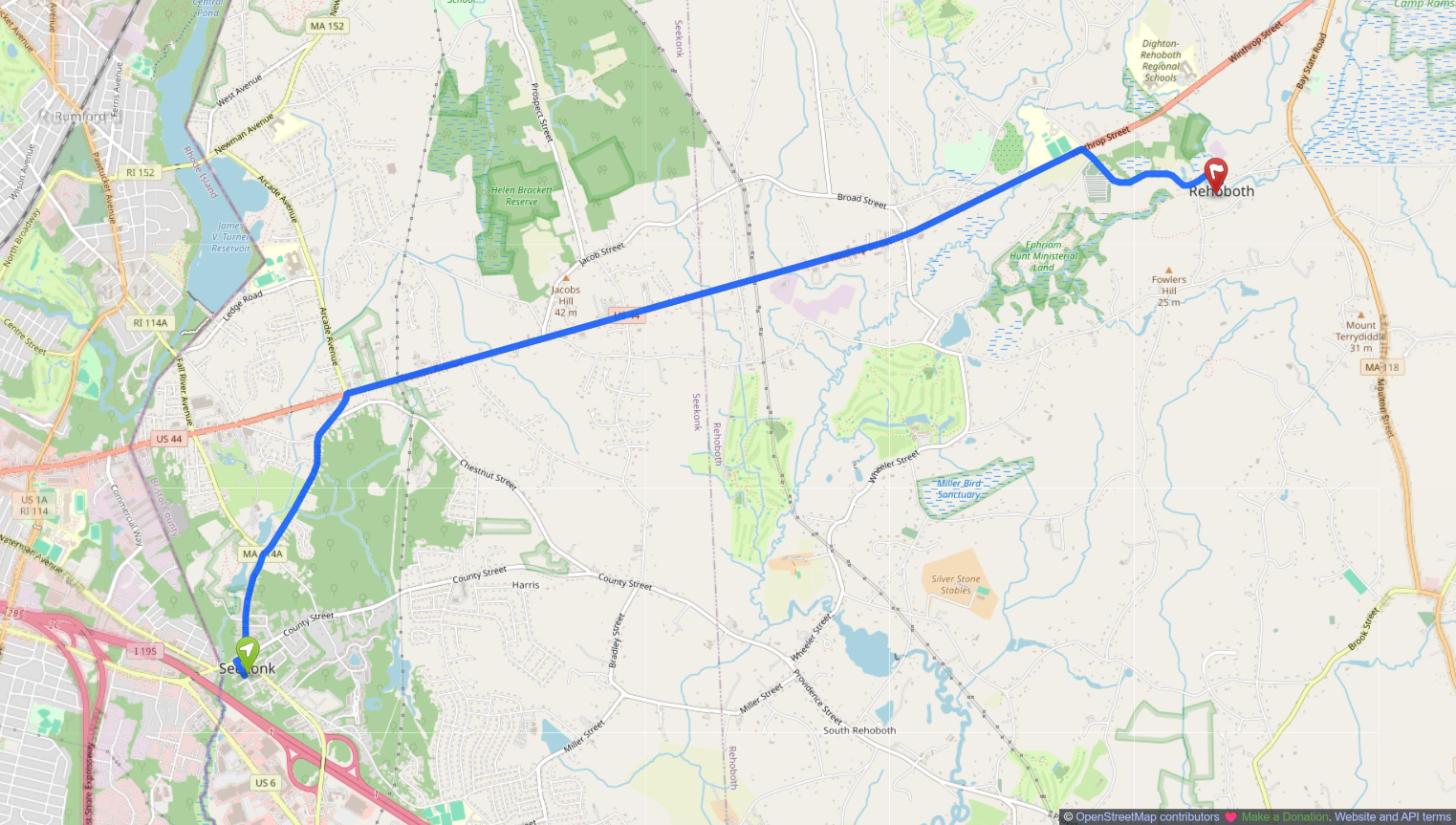
There is no single business district. The town is a set of villages: Rehoboth Village, North Rehoboth, South Rehoboth, Four Corners, Hornbine, Kingmans Corner, Pecks Corner, Perrys Corner and Perryville. U.S. Route 44 runs east to west through the middle of town and meets Route 118 near the town center. Route 6 and Interstate 195 cross the southwest corner. Providence is about 11 miles to the west.
The landmarks are historic ones: Anawan Rock, the Hornbine School built in 1845, the Carpenter Museum, and Goff Memorial Hall, which houses the Blanding Free Public Library. Rehoboth State Forest and the Shad Factory Conservation Area have hiking trails.
What local search looks like for a Rehoboth business
A town this spread out changes the math. With about 12,500 residents, searches that include the word "Rehoboth" are limited. If you run a trade, a contracting company, a farm or an event space in Rehoboth, many of your customers probably live somewhere else: Seekonk, Swansea, Dighton, Norton, the cities of Taunton and Attleboro, or across the state line in Rhode Island.
Google says it ranks local results on three things: relevance, distance and prominence. Distance works against a business that only talks about its home town. A profile and a website that mention Rehoboth alone give Google little reason to show you to someone searching in Taunton.
So the plan for a Rehoboth business has two parts. The Google Business Profile states where you work. The website proves it, with a page for each service and a page for each town that deserves one.
Page plans for four kinds of Rehoboth business
The right set of pages depends on whether you go to the customer or the customer comes to you. These are the plans I would start from.
Trades and contractors who drive to the job
One page per service, each answering: what the job includes, what it does not, what affects the cost, and what happens after the first call
Service-area pages for the towns you really work in, with photos of local jobs and details specific to that town
A page on licenses and insurance, stating which states you are set up to work in if you cross into Rhode Island
A gallery of finished work labeled by town and type of job
Call and text buttons that stay in reach on a phone
Farms that sell direct
One page that answers the three things people look up from the car: are you open, what is in season, how do I get there
Hours kept current on the site and in Google, including seasonal changes. Google's local business markup supports seasonal hours, and a profile can be marked temporarily closed for the off season
A page for each thing you sell or offer, such as a farm stand, shares, pick-your-own or wholesale
Driving directions written from the main roads, so nobody depends on a map pin alone
A simple way to post short updates when a crop comes in or sells out
Event and hospitality businesses
A page per event type, since someone planning a wedding and someone planning a company outing search differently
Capacity, what is included, parking, accessibility and rain plans stated plainly
Photos that load fast, sorted by space and season
An inquiry form that asks for date, headcount and event type so the first reply can be useful
Travel times from Providence and nearby towns, since guests rarely come from Rehoboth alone
This is the kind of site I built for Four Echoes at Grist Mill Pond in Seekonk, along with its print and signage.
Home-based professional services
A clear statement of who you serve and where: in person locally, remotely, or both
One page per service, written around the question a client types, with a direct answer in the first lines
An about page with credentials, since clients want to know who they are hiring
Booking or contact steps that do not require publishing a home address
Answers to common questions marked up so Google and AI assistants can read them
Setting up Google for a business that travels to its customers
Google treats a company that works at the customer's location as a service-area business. Its guidelines are specific, and following them matters more than any trick.
One profile. Google asks for one profile for the central location with a designated service area, not a profile per town.
Hide a home address. If you do not serve customers at your business address, Google says to remove it from the profile. A business with a staffed location that also travels can show the address and set a service area.
Service areas by town or ZIP code. You can list up to 20. Google does not let you set a radius, and the whole area should be within about two hours of driving from your base.
Your real name only. Google does not allow town names or keywords added to the business name.
Few, specific categories. Google asks for as few categories as possible, as specific as possible.
Reviews. Google states that more reviews and positive ratings can help local ranking.
The website carries the rest. Each town page needs its own content: the work you do there, photos of jobs, and details a neighbor would recognize. Google's spam policies name pages aimed at specific cities that only funnel visitors to one page as doorway abuse. A town page has to be useful on its own or it should not exist.
I built a 16-town service area page for Tree Medics and local pages covering 100+ Massachusetts towns for Curb Infusion. For multi-location businesses and franchise brands, programmatic location pages apply the same rule at larger scale.
There are limits. A website cannot change how far you are from the person searching, and no one can promise a position in Google. What you control is how clearly your profile and pages say what you do and where.
How a project runs, step by step
Conversation. We talk about the business, the towns you serve and what the current site does and does not do. In person, by phone or by video.
Proposal. I send a free proposal with the scope and the page list.
Site map and content. We agree on the pages before any design. I write or edit the copy with you, because you know the work.
Design. A custom design built around your content and photos. You review it and ask for changes.
Build and search setup. Pages, titles, structured data, redirects from old URLs, and the Google Business Profile brought in line with the site.
Review and launch. You check every page on a phone and a desktop before it goes live.
After launch. Maintenance and ongoing search work are available if you want them.
Questions to ask any web designer before you hire one
Who will actually do the work, and who do I call with a question?
Is the design custom, or a template with my logo added?
Which platform do you recommend for my business, and why that one?
Who writes the content, and how will each service and town page differ from the next?
How will you handle my Google Business Profile and my old URLs?
Can I see sites you built for businesses that serve several towns?
What happens after launch if I need changes?
Ask me the same questions. A good answer is specific and comes with examples.
Custom design on the platform that fits, including the one you already have
Every site I build is a custom design. I work in Wix Studio, WordPress, Shopify, Squarespace, Weebly and any other builder or platform available to the public. I am a Wix Legend Partner, but the platform follows the business, not the other way around.
You do not have to start over. I can redesign and optimize a site in place on an older or legacy platform left by a previous agency, as I did for Tree Medics.
Local SEO for your Google Business Profile, reviews and local pages
Programmatic SEO and location pages for businesses that cover many towns or locations
Answer engine optimization and generative engine optimization so AI tools describe your business accurately
Custom apps and Chrome extensions when an off-the-shelf tool does not fit
Rush timelines and meeting in person
Expedited timelines are available when a deadline is real. That matters most for seasonal and time-sensitive businesses: a farm before its season opens, a lighting company before the holidays, a business with an opening date. Tell me the date at the start and I will say plainly what can be ready by then.
I can meet in person anywhere in my local area, and Rehoboth is one town over. I am glad to come to your shop, farm or kitchen table and see the business before I write a word about it.
Based next door in Seekonk, serving clients across the US and Canada
I am based in Seekonk, the town on Rehoboth's western border, about 4 miles from the center of Rehoboth. I am a solo practitioner, self-employed since 2019, so you deal with me directly. I have served 150+ businesses and built 30,000+ location pages for businesses and organizations across the United States and Canada.
Call or text 508-244-0403, or email joshua@websitedesignma.com. I reply within 24 hours and the proposal is free. Tell me about your business and the towns you serve.